
The program, which is the first and only of its kind developed by a center for teaching and learning in the country, includes many CNDLS faculty who serve dual roles, such as CNDLS Executive Director and LDT Founding Director, Eddie Maloney.
The program integrates topics such as learning, design, technology innovation, learning analytics, and critical studies to teach students how to create innovative learning experiences for all learners. The program takes an interdisciplinary approach that balances theory with applied innovation at Georgetown and beyond.
Unlike similar programs, LDT is grounded in the liberal arts. “We teach the instructional design process, but also teach people how to bring their own humanity and flexibility to the field,” CNDLS Director of Faculty Initiatives and LDT Director of Graduate Studies Maggie Debelius, who teaches novels in her methods course, said. “We have a different edge to what we do, and that’s been important for the program.”
“We don’t train students with a specific skill set, otherwise we would probably have a very different curriculum,” said Maloney. “We’re training them with a capacity and a mindset to understand what higher education is, and what it means to build relationships, and how you need to marry a strong expertise with a capacity to be a leader in this space.”
Many students who are accepted into the LDT program are also offered the opportunity to do meaningful work as graduate associates at CNDLS. These applied learning experiences at CNDLS, combined with projects they complete in their courses, allow them to graduate with a portfolio that includes real-world experience, and the student employment also helps to defray the cost of their graduate education. CNDLS benefits from their contributions just as much as the students do, leaning on their talents and perspectives to conduct and improve the center’s work.
Some LDT graduates recently shared their experiences with the program and how it prepared them to be leaders in the field.
Hannah Schneider (G’23)
Current Occupation: Director of Digital Education Programs at American Association of Colleges and Universities (AAC&U)
The LDT program stood out to me because of the interactive nature, small setting, and breadth of course offerings. When I applied, I was hoping to explore my interest in design and to further the work I was already doing at my job at the time. The other programs I looked at in instructional design were more focused on the output and less about the process of design. Additionally, I saw a lot of programs that were entirely online or entirely in person, with bigger class sizes and cohorts.
I was very impressed with the program by the end, especially the culture of genuine curiosity and the theoretical pieces that I was able to explore—creativity, the future of higher education, and the university as a design problem. I’m currently the director of digital education programs at AAC&U, and I certainly wouldn’t have that role without LDT. I use what I learned in LDT to design my digital education initiatives here.

All of the classes truly impacted me, but David Ebenbach’s course on creativity in design is one I think about almost daily. I came into the course very skeptical as I had never considered myself creative in any way, but I came out of that course as someone who is confident in my own understanding of creativity and communal design. I use what I learned in his class in everything I design in my current role. Bryan Alexander’s course on technology and Ijeoma Njaka’s course on applied learning design also influenced me.
I would tell future LDT students to take advantage of the time you have! It’s such a great space to ask questions and to truly learn about yourself and design.
Jordan Davis (G’24)
Current Occupation: Faculty Development Specialist at Wilmington University
In my statement of purpose for my LDT application, I noted interest in the leadership and instructional design tracks of the program. Higher education leadership, instructional design, education consulting, and a corporate career in education technology were all viable options for me, and I hoped that LDT would help narrow my choices and equip me with the necessary skills to pursue at least one. What I didn’t expect, though, was to discover the career path I’m on now: faculty development. My graduate associateship at CNDLS allowed me to directly apply what I was learning in my courses to my work with Georgetown’s phenomenal instructors—a unique, career-changing experience that exceeded my expectations.
The program was extremely collaborative. Peer engagement was designed into our courses, informally promoted by our instructors, and carried out through the kindness and selflessness of my classmates. The program was also extremely diverse, with students hailing from all over the world.
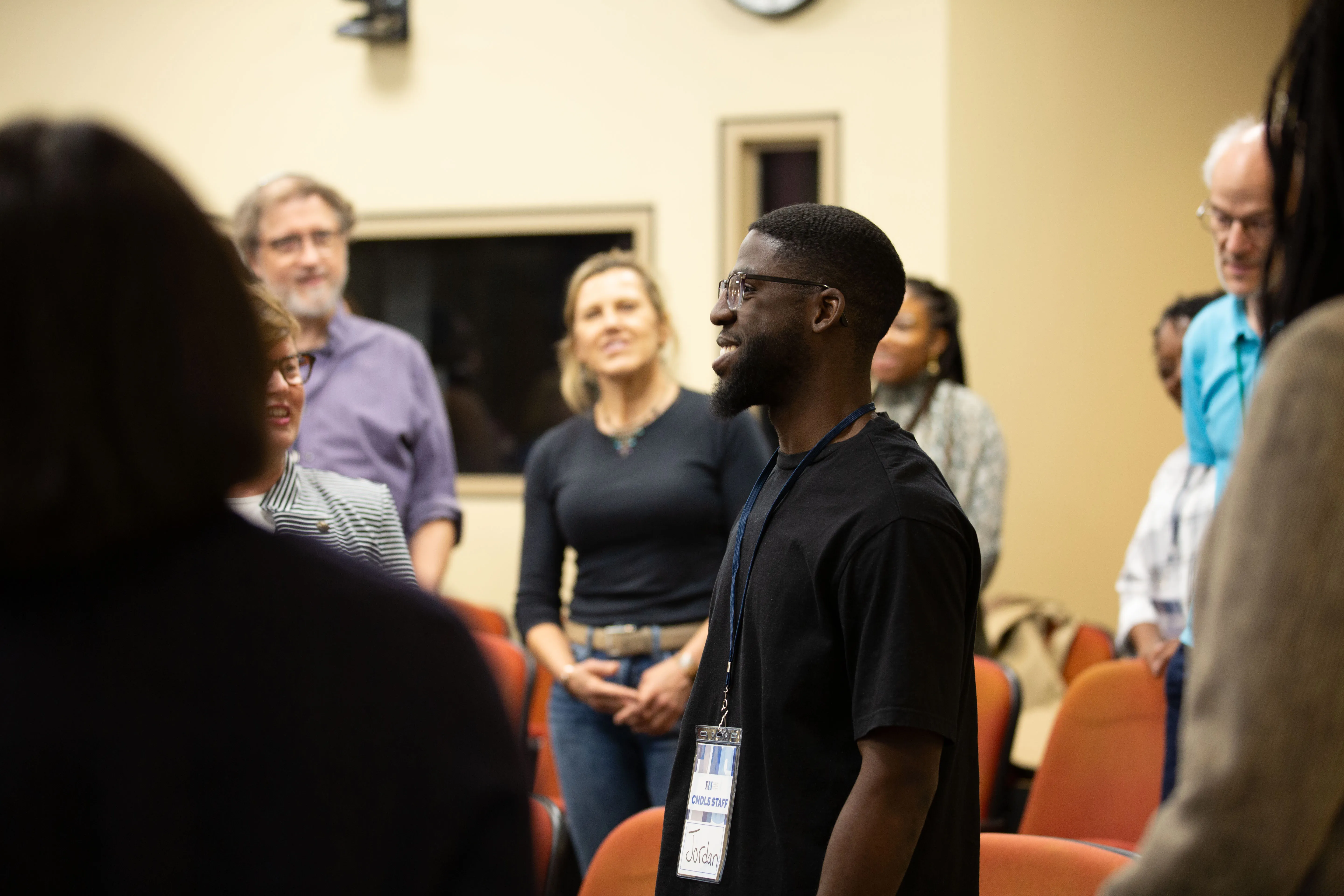
Many instructors—Ijeoma Njaka, David Ebenbach, and Dawan Stanford, to name a few—taught me how to think like a designer. I have always suffered from perfectionism, and good design requires embracing imperfection. I now give myself permission to create “crappy first drafts.” It’s critical to build low-fidelity versions of products, experiences, or policies, and share them with cocreators and intended audiences to integrate their feedback. I use collaborative design principles in my work daily as a result of the wisdom shared by these expert designers.
In the words of Bill Burnett, life is one of our biggest design challenges. Design thinking—a five-step, human-centered design methodology used to create learner-centered educational experiences—was a prominent theme and design tool used throughout the program. I use design thinking to craft the programming I deliver in my work as a faculty development specialist. I also use it to design my life, viewing my current personal and professional experiences as prototypes of the life I ultimately want to live.
Oluwafikayo “Fikayo” Odugbemi (G’25)
Current Occupation: Faculty Development Specialist at the New York Institute of Technology
I was interested in a program that combined learning, design thinking, and technology because I had worked in all three industries separately but really wanted a career track that brought them together and where I could use all skills. I was particularly interested in exploring higher education frameworks through a design and technology lens. During my search for a program, LDT was the most attractive option for two reasons. First, it had a design studio and a course on game design. The design studio communicated to me that there would be significant investments in honing design skills, and I’d always wanted to do something in game design, so I was really excited by that opportunity. Second, the program was completely project based, with no exams or final thesis. This really attracted me because I’m famously a bad test taker who did poorly in more traditional learning environments. The program design was a perfect fit for my learning style and abilities!

I feel like I got something meaningful from every class and every class shaped me significantly. But a class that shaped a lot of my central philosophy in the work I do now is Critical Speculative Design for Anti-Racism in Higher Education. Professor Ijeoma Njaka took me on a journey that truly rocked my world—I had all these loose ideas, ways of thinking, and visions, and through that class I was able to find a home and co-conspirators that gave them shape and brought into focus a lot of what I’d been struggling to articulate to myself and others. It truly legitimized my way of being. I feel very grateful and blessed to have been taught by her, to be in that class, and to be in that cohort of people. We ended up taking that class further by starting a book club that eventually became a workshop at TLISI! It was great.
Right now, I’m able to move very easily through different contexts in higher education thanks to my teachers and exposure to different ways of thinking. I’m a faculty developer at a small teaching and learning center, and I regularly use the lessons from working at CNDLS, being in my LDT classes, and talking to my teachers and peers. Because of one of my classes with Yianna Vovides and Maggie Debelius, I worked on a project that evolved into two conference presentations and won a professional development award based on that work. That then led to me now being an associate editor on a journal shaping conversations in the field of educational development. Everything I’m doing in my career is very much because of the ways I was prepared during my time in LDT.