
Eddie: CNDLS started in some ways as a response to the 1997 Intellectual Life Report, a decennial report on the overall health and functioning of Georgetown across numerous areas. There was context around the increase in technology and where we were going and its relationship to teaching and learning. What's your sense of how CNDLS began?
Randy: Like you say, talk of learning was in the air. Technology was certainly starting to emerge on the scene and people felt like there were new tools they didn't know how to use. We started the Teaching, Learning, and Technology Roundtable in 1994. That was captured in the Intellectual Life Report.
In 1999, two years after the report, Dorothy Brown, the then-provost, and Dave Lambert, the then-chief information officer (CIO) and head of University Information Services (UIS), called me into Dorothy's office and asked me if I'd be interested in starting and leading a center for teaching and technology for Georgetown.
I put together a plan and we conferred on that in those early years. But then at the same time, the President's Office—possibly in response to the Intellectual Life Report—formed a committee for an institute of pedagogy for Georgetown. I was on that com- mittee, but by the time that committee had started, I had already fully drafted a plan for the center that Dorothy and Dave had asked me to start. So by the end of that spring, CNDLS had been ratified by everyone. We opened our doors in Fall 2000.
Eddie: When you were thinking about establishing CNDLS, drafting that proposal for Dave and Dorothy—which, as an aside, it's amazing to think about the role IT played in a teaching and learning center and what it meant—what you were thinking about? Were there similar centers or places that you were looking to? What were the driving ideas that you had?
Randy: I agree. It was kind of amazing that they came together. I think it said a lot about Dave and Dorothy, but also maybe that moment.
When they first called me in, they wanted to start a center for teaching and technology and wanted to know if I'd be willing to lead it. I said, no, I'm not interested in starting a center for teaching with technology, but I would be interested in starting a comprehensive center for teaching and learning. So I was already fixed on doing something that was unusually comprehensive.
I had started to work with the Carnegie Foundation on the scholar- ship of teaching and learning. I knew that I wanted the center to also be very focused on the concept of learning as the driver of change, and technology was in service to that. I had this very compre- hensive model in my head, and I wanted to make sure it covered all grounds and connected assessment with learning with technology. There were a few centers that I admired that were up and running. The University of Michigan's Center for Research on Learning and Teaching was very well-known. Stanford University had a big center. But I don't remember any particular model I was trying to emulate as much as believing that the most important path to long-term success and the kind of change that I hoped to see was to make it comprehensive.
Eddie: I think that was not something that you saw elsewhere. One of the things that we thought a lot about early on was getting people through the door because they had a technology problem, but really shifting that conversation to teaching and learning quickly.
Randy: It kind of worked in all directions, right? Somebody might come in with a pedagogy issue and it turns out that some piece of technology or some technologically-based pedagogy could help them enhance the interactivity of their course. Or they might walk in with an assessment issue and assessment led them to pedagogy or technology. It was a big key to success that we could meet people where they were, but had many other options and doors to take them through.
Eddie: What did the first few years of the operation look like? My recollection is we started with about two and a half people, including a graduate student or a couple half-time staff. What was your sense of how we built from the beginning?
Randy: For our initial funding, we had $100,000 from the provost and $100,000 from the CIO in UIS. Out of that, we hired a couple of full-time staff and a graduate student. But by the end of that first year, we actually had a budget of $700,000, with $500,000 of that coming through philanthropy.
Through a different channel, I received a grant from a phi- lanthropy to launch a very large scale collaborative project. We were able to fund a good deal of CNDLS staff off of that because we integrated it fully. By the end of that first year, we actually had about seven people working for us.
At the end of that year, after sending in my annual report to Dorothy Brown, the first thing she said was, “there is money in this report.” We had done so much in the first year that we had already made the case that she could go to the deans and say, “everybody has to buy into this.”
By the end of the second year, the Office of the Provost contribution had quadrupled.
I think a very important part of getting CNDLS launched in its trajectory was that we had many different programs up and running in almost no time. And I think that is what also distin- guished it from a lot of other centers. The fact that we had significant philanthropy from the beginning, even more than we had from the institution, allowed us to actually build out a value proposition for the center that was really unique and highly accelerated.
Eddie: Some of that philanthropy led to a national project called the Visible Knowledge Project (VKP). Can you talk a little bit about that project and what it meant for CNDLS?
Randy: The Visible Knowledge Project was focused on the scholarship of teaching and learning, involving about 70 fac- ulty on 21 different college and university campuses. It was a fantastically cross-sector project with faculty doing inquiry on the relationship between their new pedagogies and student learning, with a particular focus on new technologies and new media technologies. It was also looking at the role of technol- ogy in teaching in the humanities, which was very unusual because most of the financial energy around technology was going into distance learning and STEM nationally at that time. It was very important to the on-campus identity of CNDLS to be a national presence, to have a self-image that we can't be a leader on campus if we're not seen as a leader to the sector.
Eddie: It was an amazing project. A lot of friendships and future CNDLS staff came from VKP, and a lot of our work that we did over the next decade built on a lot of the work that happened on VKP as well.
Randy: We of course had a campus-based cohort, but it was also just the ethos.
Eddie: One of the roles that I had when I first got to George- town was a position in what we called the Research, Curriculum, and Development (RCD) group. It was out of UIS and had Ph.D.s and different disciplines supporting technology in the class- room. I did work helping to support the humanities. And we worked together with CNDLS.
Randy: By 2003, CNDLS was already quite a strong presence on campus. We were certainly connecting with the RCD group and shared a lot of interests. We might even have been co-located.
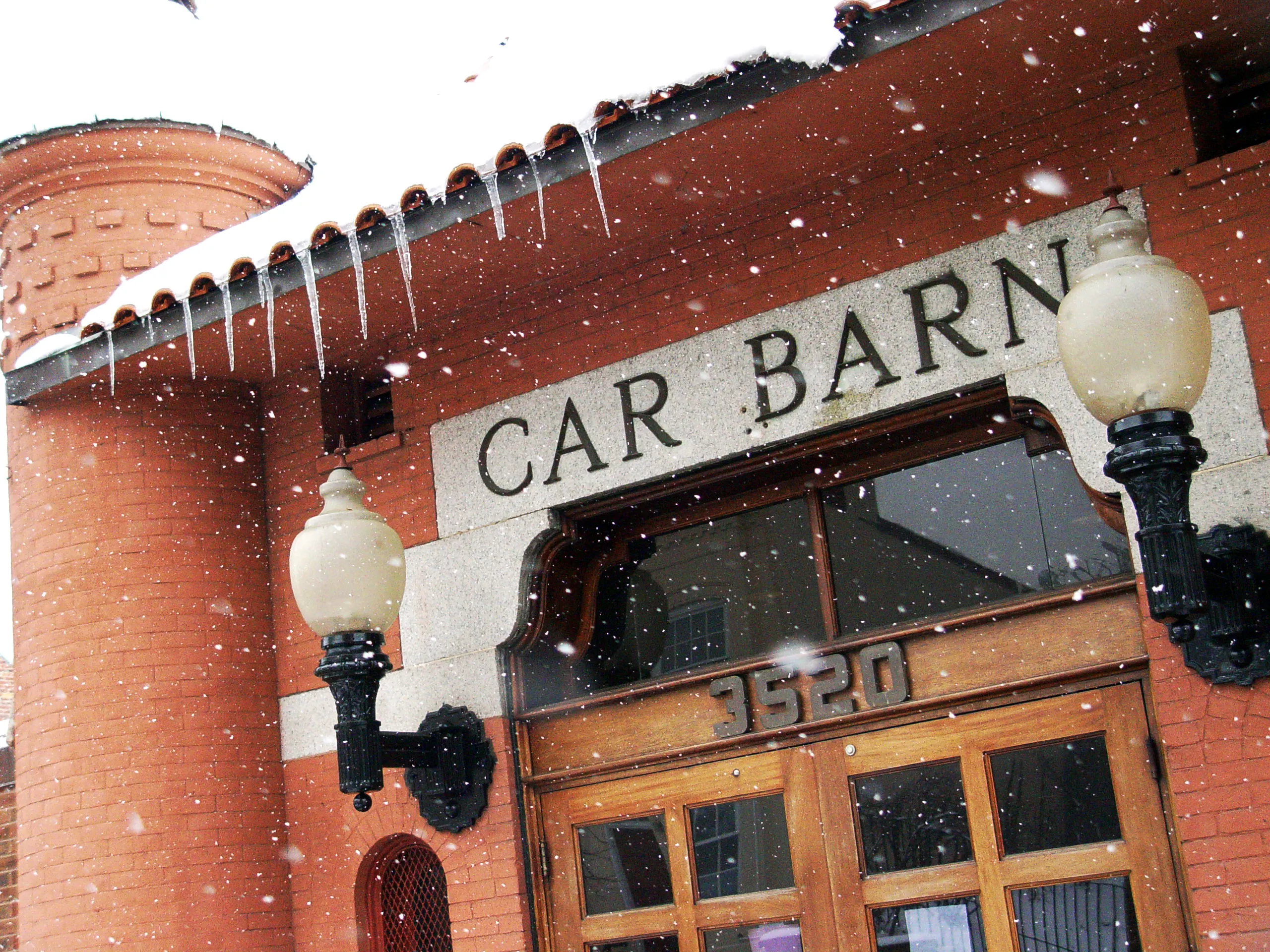
Eddie: Yes, we were all in Car Barn 314.
Randy: And you were already playing a bridging role there. So you were already, in essence, helping to lead CNDLS. I've never really known for sure why, but CIO Dave Lambert gen- erously said, "I'm moving these five or six lines and giving them to you."
I figured there had to be an incredibly important reason why anybody would give away six lines. And I think it was because that was back at a moment when the university's technolog- ical infrastructure was not up to the task of how fast things were moving.
Dave saw he had a lot of things to worry about and growing the academic connection of technology couldn't be one of the things. And it was clear that for this really to work, they had to be integrated. It was an opposite move from everything I had seen in the '90s about what was happening at a lot of other schools where things were being separated and orphaned. In effect, it almost doubled the size of CNDLS. And of course, it brought you in as a leader and you became managing director. From that moment on, we were co-leading the organization. What are your memories of those early years?
Eddie: It was really interesting. You mentioned the co-location. We had created a little bit of space for CNDLS. But we had the chief budget officer for the Office of the Provost in the suite, as well as some UIS folks. We just had these different groups of people who were all working together. It was a very eclectic space. And I remember the cultural shift that CNDLS brought to that conversation. Part of the serious ethos of investing in scholarship was true, but we are also here to try to do something interesting and fun, and to bring something to the university that helps people care about teaching and learning, and maybe in a way that they hadn't been before because we have this new problem or this new opportunity. A lot of the folks who started in CNDLS were your former graduate students, right? They were all young, and everyone in UIS was just of a different generation. Same thing with the RCD. So it was a shift in culture. And that was exciting and really quite fascinating.
Randy: There was a sense of play and more of a people focus. I think it's natural if you're working inside a technology center that you’re tool focused, but it's really about the user experience and learning, relationships, and trust.
Eddie: One of the other things that often comes to mind when asked about the early ethos of CNDLS is the need to have food for people to come and to create that sense of community. And I think that's one of the things that we did so well in the early days and continue to do really well.
Randy: Or even just creating a relaxed space. There weren't that many places on campus for faculty from different schools and different departments to meet each other. I remember hearing from multiple faculty that people referred to CNDLS as their second intellectual home. Their first intellectual home was their department, but CNDLS became a second place for them, and often a place where they could feel freer to be honest and express their interest in teaching and learning. So CNDLS became both this safe and intellectually stimulating place. What would you say would be another one or two things that you thought were the keys to success in that first decade?
Eddie: I think that sense of community was so important. But I also just think we had ideas that people started to resonate with. Early on, we started to connect with the sense of well-being and what that meant. Working with Joan Riley to bring Engelhard to CNDLS was really important.
I think some of the projects that had a kind of intellectual founda- tion that were driven by learning science became really important, such as making thinking visible, which was the foundation for the Visible Knowledge Project. Also Bottlenecks and Thresholds was a project that we ran around 2007. We were really trying to help people unpack their relationship as experts.
I'm curious if you think any of those intellectual models resonate today?
Randy: I think a couple of them are extremely relevant. Bottlenecks and Thresholds was our own putting-together of two completely different ideas that could be complementary.
Another was the threshold concept theory that had come out of work happening in the U.K. that was about disciplinary knowledge and how disciplines create these thresholds or portals that stu- dents have to pass through to be able to do more advanced work. And then Bottlenecks came out of the Decoding the Disciplines work that had come out of Indiana University Bloomington, which had a very structured way of helping faculty recognize their own expert blind spots.
There's some ways in which if you're an expert in a field, you're the least well-qualified person to teach that field to novices. So what was observed from Decoding the Disciplines was that there were all these steps that experts skipped because it just came naturally. And it was all part of making knowledge visible. One of the things that was really powerful was that we were very much devoted to helping faculty see that many of the keys to unlocking learning for their students began with their expertise.
When I think about the challenges early on, I do remember there was some critique that we were over-rationalizing what was essen- tially an art. Teaching was about your discipline and your love of teaching, and that was all you needed to get you through. And I think the theories that we really used early on were all about mak- ing a bridge. So when you say "is it time to bring those things back," I think we think about the impact that artificial intelligence is going to have on just disrupting the entire nature of knowledge production, learning, assessment, how we convey knowledge, and what it is that we actually think we're teaching.
Eddie: I couldn't agree more. And I've asked my staff, especially in the last couple years, to think about how we can actually re- invest in those spaces.
One of the interesting things to me about over-rationalizing teaching is that there are some people who are experts and can- not explain steps, but it's probably the same thing for people who are natural teachers, the people who are really gifted at unpack- ing things with students who are able to do that work. They don't necessarily know how or why, so then sharing that with others is a challenge.
To me, that's one of the roles that a center for teaching can play, right? It can help the expert teachers unpack that space as well. I think one of the things about not just the first decade, but just generally CNDLS over the past 25 years is that we've helped culti- vate that community of expert teachers who are interested and willing to share that knowledge with their colleagues.
It's not just us trying to share that. It's having a space where we have people at the university who are really good at what they do and want to help their colleagues get to be better at it as well. And that's just a lovely environment to be in.